Wednesday, October 17, 2012

Tao cognition: history and hypothesis

© Igor Morski
The authors continue the analysis of the various approaches to the cognitive science examining the mainline - cognitivism - and outlining its historical evolution and the central points of the founding hypothesis - cognition as computation of representations realized as symbols, in the brain or a machine:

Symbols: The Cognitivist Hypothesis

The Foundational Cloud

Our exploration of cognitive science and human experience begins in this chapter with an examination of cognitivism - the center of our diagram - and its historical origins in the earlier, cybernetic era of cognitive science. The main idea to be presented … is that the analysis of mind undertaken by certain traditions of mindfulness/awareness provides a natural counterpart to present-day cognitivist conceptions of mind. This chapter presents the cognitivist perspective.
Let us begin by looking at the historical roots of present-day cognitivism. This short historical excursion is necessary, for a science that neglects its past is bound to repeat its mistakes and will be unable to visualize its development. Our excursion here is, of course, not intended to be a comprehensive history but only to touch on those issues of direct relevance for our concerns here. In fact, virtually all of the themes in present-day debates were already introduced in the formative years of cognitive science from 1943 to 1953. History indicates, then, that these themes are deep and hard to pursue. The "founding fathers" knew very well that their concerns amounted to a new science, and they christened this science with the new name cybernetics. This name is no longer in current use, and many cognitive scientists today would not even recognize the family connections. This lack of recognition is not idle. It reflects the fact that to become established as a science in its clear-cut cognitivist orientation, the future cognitive science had to sever itself from its roots, which were complex and entangled but also rich with possibilities for growth and development. Such a severance is often the case in the history of science: it is the price of passing from an exploratory stage to a full-fledged research program - from a cloud to a crystal. The cybernetics phase of cognitive science produced an amazing array of concrete results, in addition to its long-term (often underground) influence:

  • The use of mathematical logic to understand the operation of the nervous system
  • The invention of information-processing machines (such as digital computers), thereby laying the basis for artificial intelligence
  • The establishment of the metadiscipline of systems theory, which has had an imprint in many branches of science, such as engineering (systems analysis, control theory), biology (regulatory physiology, ecology), social sciences (family therapy, structural anthropology, management, urban studies), and economics (game theory)
  • Information theory as a statistical theory of signal and communication channels
  • The first examples of self-organizing systems
This list is impressive: we tend to consider many of these notions and tools an integral part of our lives. Yet they were all nonexistent before this formative decade, and they were all produced by an intense exchange among people of widely different backgrounds. Thus the work during this era was the result of a uniquely and remarkably successful interdisciplinary effort. The avowed intention of this cybernetics movement was to create a science of mind. In the eyes of the leaders of this movement, the study of mental phenomena had been far too long in the hands of psychologists and philosophers. In contrast, these cyberneticians felt a calling to express the processes underlying mental phenomena in explicit mechanisms and mathematical formalisms.
One of the best illustrations of this mode of thinking (and its tangible consequences) was the seminal 1943 paper by Warren McCulloch and Walter Pitts, “A Logical Calculus of Ideas Immanent inNervous Activity.” Two major leaps were taken in this article: first, the proposal that logic is the proper discipline with which to understand the brain and mental activity, and second, the claim that the brain is a device that embodies logical principles in its component elements or neurons. Each neuron was seen as a threshold device, which could be either active or inactive. Such simple neurons could then be connected to one another, their interconnections performing the role of logical operations so that the entire brain could be regarded as a deductive machine.
These ideas were central for the invention of digital computers. At that time, vacuum tubes were used to implement the McCulloch-Pitts neurons whereas today we find silicon chips, but modem computers are still built on the same so-called von Neumann architecture that has been made familiar with the advent of personal computers. This major technological breakthrough also laid the basis for the dominant approach to the scientific study of mind that was to crystalize in the next decade as the cognitivist paradigm.
In fact, Warren McCulloch, more than any other figure, can serve as an exemplar of the hopes and the debates of these formative years. As can be gleaned from his collected papers in Embodiments of Mind, McCulloch was a mysterious and paradoxical figure whose tone was often poetic and prophetic. His influence seemed to wane during the later years of his life, but his legacy is being reconsidered as cognitive science becomes more aware that a thorough intertwining of the philosophical, the empirical, and the mathematical, which McCulloch's investigations exemplified, seems the best way to continue working.
His favorite description for his enterprise was "experimental epistemology" - an expression not favored by current usage. It is one of those remarkable simultaneities in the history of ideas that in the 1940s the Swiss psychologist Jean Piaget coined the expression "genetic epistemology" for his influential work, and the Austrian zoologist Konrad Lorenz started to speak of an "evolutionary epistemology."
There was, of course, considerably more to this creative decade. For instance, there was extensive debate over whether logic is indeed sufficient to understand the brain's operations, since logic neglects the brain's distributed qualities. (This debate continues today, and we will consider it in more detail later, especially as it relates to the question of "levels of explanation" in the study of cognition.) Alternative models and theories were put forth, which for the most part were to lie dormant until they were revived in the 1970s as an important alternative in cognitive science.
By 1953 the main actors of the cybernetics movement, in contrast to their initial unity and vitality, were distanced from each other, and many died shortly thereafter. It was mainly the idea of mind as logical calculation that continued.

Defining the Cognitivist Hypothesis

Just as 1943 was clearly the year in which the cybernetics phase was born, so 1956 was clearly the year that gave birth to cognitivism. During this year, at two meetings held at Cambridge and Dartmouth, new voices (such as those of Herbert Simon, Noam Chomsky, Marvin Minsky, and John McCarthy) put forth ideas that were to become the major guidelines for modern cognitive science.
The central intuition behind cognitivism is that intelligence - human intelligence included -so resembles computation in its essential characteristics that cognition can actually be defined as computations of symbolic representations. Clearly this orientation could not have emerged without the basis laid during the previous decade. The main difference was that one of the many original, tentative ideas was now promoted to a full-blown hypothesis, with a strong desire to set its boundaries apart from its broader, exploratory, and interdisciplinary roots, where the social and biological sciences figured preeminently with all their multifarious complexity.
What exactly does it mean to say that cognition can be defined as computation? As we mentioned a computation is an operation that is carried out or performed on symbols (on elements that represent what they stand for). The key notion here is that of representation or "intentionality," the philosopher's term for aboutness. The cognitivist argument is that intelligent behavior presupposes the ability to represent the world as being certain ways. We therefore cannot explain cognitive behavior unless we assume that an agent acts by representing relevant features of her situations. To the extent that her representation of a situation is accurate, the agent's behavior will be successful (all other things being equal).
This notion of representation is - at least since the demise of behaviorism - relatively uncontroversial. What is controversial is the next step, which is the cognitivist claim that the only way we can account for intelligence and intentionality is to hypothesize that cognition consists of acting on the basis of representations that are physically realized in the form of a symbolic code in the brain or a machine.
According to the cognitivist, the problem that must be solved is how to correlate the ascription of intentional or representational states (beliefs, desires, intentions, etc.) with the physical changes that an agent undergoes in acting. In other words, if we wish to claim that intentional states have causal properties, we have to show not only how those states are physically possible but how they can cause behavior. Here is where the notion of symbolic computation comes in.
Symbols are both physical and have semantic values. Computations are operations on symbols that respect or are constrained by those semantic values. In other words, a computation is fundamentally semantic or representational - we cannot make sense of the idea of computation (as opposed to some random or arbitrary operation on symbols) without adverting to the semantic relations among the symbolic expressions. (This is the meaning of the popular slogan "no computation without representation.") A digital computer, however, operates only on the physical form of the symbols it computes; it has no access to their semantic value. Its operations are nonetheless semantically constrained because every semantic distinction relevant to its program has been encoded in the syntax of its symbolic language by the programmers. In a computer, that is, syntax mirrors or is parallel to the (ascribed) semantics. The cognitivist claim, then, is that this parallelism shows us how intelligence and intentionality (semantics) are physically and mechanically possible. Thus the hypothesis is that computers provide a mechanical model of thought or, in other words, that thought consists of physical, symbolic computations. Cognitive science becomes the study of such cognitive, physical symbol systems.
To understand this hypothesis properly, it is crucial to realize the level at which it is proposed. The cognitivist is not claiming that if we were to open up someone's head and look at the brain, we would find little symbols being manipulated there. Although the symbolic level is physically realized, it is not reducible to the physical level. This point is intuitively obvious when we remember that the same symbol can be realized in numerous physical forms. Because of this nonreducibility it is quite possible that what corresponds to some symbolic expression at the physical level is a global, highly distributed pattern of brain activity. We will return to consider this idea later. For now the point to be emphasized is that in addition to the levels of physics and neurobiology, cognitivism postulates a distinct, irreducible symbolic level in the explanation of cognition. Furthermore, since symbols are semantic items, cognitivists also postulate a third distinctly semantic or representational level. (The irreducibility of this level too is intuitively obvious when we remember that the same semantic value can be realized in numerous symbolic forms.)
This multilevel conception of scientific explanation is quite recent and is one of the major innovations of cognitive science. The roots and initial formulation of the innovation as a broad scientific idea can be traced back to the era of cybernetics, but cognitivists have contributed greatly to its further rigorous philosophical articulation. We would like the reader to keep this idea in mind, for it will take on added significance when we tum to discuss the related - though still controversial - notion of emergence.
The reader should also notice that the cognitivist hypothesis entails a very strong claim about the relations between syntax and semantics. As we mentioned, in a computer program the syntax of the symbolic code mirrors or encodes its semantics. In the case of human language, it is far from obvious that all of the semantic distinctions relevant in an explanation of behavior can be mirrored syntactically. Indeed, many philosophical arguments can be given against this idea. Furthermore, although we know where the semantic level of a computer's computations comes from (the programmers), we have no idea how the symbolic expressions supposed by the cognitivist to be encoded in the brain would get their meaning.
Since our concern is with experience and cognition in its basic, perceptual modality, we will not take up such issues about language in detail here. Nonetheless, they are worth pointing out, since they are problems that lie at the heart of the cognitivist endeavor.
The cognitivist research program can be summarized, then, as answers to the following fundamental questions:
Question 1: What is cognition?
Answer: Information processing as symbolic computation-rule-based manipulation of symbols.
Question 2: How does it work?
Answer: Through any device that can support and manipulate discrete functional elements-the symbols. The system interacts only with the form of the symbols (their physical attributes), not their meaning.
Question 3: How do I know when a cognitive system is functioning adequately?
Answer: When the symbols appropriately represent some aspect of the real world, and the information processing leads to a successful solution of the problem given to the system.

1956 Tao


Tuesday, October 16, 2012

Tao neither supernatural nor mechanical - III

Scintillation Grid
With regard to the supernatural, I believe that the data in many cases simply are not as represented and do not support – much less prove – what it is claimed they should prove. I also believe that the claims made are so unlikely to be valid, so difficult to believe, that very strong evidential proof would be needed. The matter has been put in words stronger than mine:

No testimony is sufficient to establish a miracle, unless the testimony be of such a kind, that its falsehood would be more miraculous than the fact which it endeavors to establish: And even in that case there is a mutual destruction of arguments, and the superior only gives us an assurance suitable to that degree of force, which remains, after deducting the inferior.
(David Hume, “Of Miracles” in “An Inquiry Concerning Human Understanding. Essays and Treatises”)

It is that mutual destruction of arguments which most convinces me that there are not believably at the present time any miracles in which it is easier to believe than to doubt the attesting evidence.
The trouble is that belief in a claimed miracle must always leave the believer open to all belief. By accepting two contradictory kinds of explanation (both the ordered and the supernatural), he sacrifices all criteria of the incredible. If some proposition is both true and false, then all propositions whatsoever are and must be both true and false. All questions of belief or doubt then become meaningless. It is in this context that the concept of heresy assumes its importance. However, if heresy be defined as internally contradictory opinion about some major premise of life and religion, then belief in the supernatural is ultimately “heresy”.
An example will perhaps make this matter more clear. I recently attended a séance at which a professed (and professional) psychic painted about twenty pictures in about two hours. These pictures he signed with the names of various deceased and famous artists – Picasso, Monet, Toulouse-Lautrec, Rembrandt, etc. And indeed each painting was recognizably in the style of the artist whose name was signed on it. The psychic claimed that the spirit of the deceased artist controlled him in the act of painting and that, without such control, he himself did not know how to draw.
Some days later, a little girl, four years old, defaced with a marking pen one of these paintings, which was signed “Monet”. The members of the community were horrified. I suggested, however, that this sequence of events proved the reality of ghosts. Clearly Monet, somewhere in the land of the dead, had become aware, by ESP, of the monstrous impersonation which had been perpetrated upon him, and had come back to earth in rage, where he had possessed the little girl, guiding her hand as she defaced the picture. I pointed out that the defacing marks were surely genuine Monet and should fetch several thousand dollars at auction. Or was the whole picture a “genuine Monet”? Either hypothesis is as credible (or incredible) as the other. The introduction of the supernatural into the scheme of explanation destroys all belief and all disbelief, leaving only a state of mind, completely gaga, but which some find pleasant.
The great variety of supernaturalist superstition with which we are currently blessed seems to depend on a rather small number of misconceptions. Thus, I believe that the receipt of information, whether by organisms or machines, always occurs by way of material pathways and end organs which are, in principle, identifiable. This rules out such variants of extrasensory perception as telepathy, distance perception, second sight, etc. It also excludes that superstition called the inheritance of acquired characteristics. It does not, of course, exclude the possibility that men, animals, or machines may have organs of sense of which we are still unaware. But in discussion with friends who believe in ESP, I find that any simple explanation of what they assert is not all what they hope for.

Tao neither supernatural nor mechanical - II

de-formed Tao

Ray and Maria Stata Center, MIT, Cambridge, US


Noam Chomsky

 Ray and Maria Stata Center

Monday, October 15, 2012

mental Tao components: structures

© Robert Fathauer, Infinity
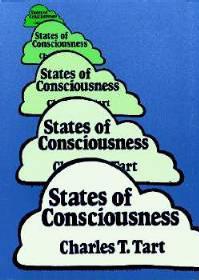
In the system components description of states of consciousness Tart, after introducing the first two - awareness and energy - describes the third: structures.

Structures
The mind, from which consciousness arises, consists of myriad structures. A psychological structure refers to a relatively stable organization of component parts that perform one or more related psychological functions. We infer (from outside) the existence of a particular structure by observing that a certain kind of input information reliably results in specific transformed output information under typical conditions. For example, we ask someone, "How much is fourteen divided by seven?" and he answers, "Two." After repeating this process, with variations, we infer the existence of a special structure or related set of structures we can call arithmetical skills. Experientially, we infer (from inside) the existence of a particular structure when, given certain classes experienced input information, we experience certain transformed classes of output/response information. Thus, when I overhear the question about fourteen divided by seven and observe that some part of me automatically responds with the correct answer, I infer an arithmetical skills structure as part of my own mind. We hypothesize that structures generally continue to exist even when they are not active, since they operate again when appropriate activating information is present. I again know that fourteen divided by seven equals two, even though I stopped thinking about it for a while. The emphasis here is on the structure forming something that has a recognizable shape, pattern, function, and process that endure over time. Ordinarily we are interested in the structure's overall properties as a complete structure, as a structured system, rather than in the workings of its component parts. Insofar as any structure can be broken down into substructures and sub-substructures, finer analyses are possible ad infinitum. The arithmetical skill structure can be broken down into adding, subtracting, multiplying, or dividing substructures. Such microscopic analyses, however, may not always be relevant to an understanding of the properties of the overall system, such as the state of consciousness, that one is working with. the most obvious thing that characterizes an automobile as a system is its ability to move passengers along roads at high speed; a metallurgical analyses of its spark plugs is not relevant to an understanding of its primary functioning and nature. Our concern, then, is with the psychological structures that show functions useful to our understanding of consciousness. Such structures can be given names—sexual needs, social coping mechanisms, language abilities. Note that some structures may be so complex that we are unable to recognize them as structures. We see only component parts and never understand how they all work together. A psychological structure may vary in the intensity and/or the quality of its activity, both overall and in terms of its component parts, but still retain its basic patterns (gestalt qualities) and so remain recognizably the same. A car is usefully referred to as a car whether it is moving at five or twenty-five miles an hour, whether it is red or blue, whether the original spark plugs have been replaced by spark plugs of a different brand. We anticipate an understanding of a state of consciousness as a system here. Some structures are essentially permanent. The important aspects of their functioning cannot be modified in any significant way; they are biological/physiological givens. They are the hardware of our mental system. To use an analogy from computer programming, they are fixed programs, functions built into the machinery of the nervous system. Some structures are mainly or totally given by an individual's particular developmental history; they are created by, programmed by, learning, conditioning, and enculturation processes that the individual undergoes. This is the software of the human biocomputer. Because of the immense programmability of human beings, most of the structures that interest us, that we consider particularly human, are in this software category. Permanent structures create limits on, and add qualities to, what can be done with programmable structures: the hardware puts some constraints on what the software can be. The physiological parameters constituting a human being place some limits on his particular mental experience and his possible range of programming. Our interest in relatively permanent structures, one that are around long enough for us conveniently to observe, experience and study. But all the theoretical ideas in this book should be applicable to structures that are not long-lasting, even though investigation may be more difficult. Structure, for the outside investigator, are hypothesized explanatory entities based on experiential, behavioral, or psychological data. They are also hypothesized explanatory concepts for each of us in looking at his own experience: I know that fourteen divided by two equals seven, but I do not experience the arithmetical skills structure directly; I only know that when I need that kind of knowledge, it appears and functions. Since I need not hold on consciously to that knowledge all the time, I readily believe or hypothesize that it is stored in some kind of structure, someplace "in" my mind.

the sweet sound of Tao


Il dolce suono mi colpi di sua voce!
Ah, quella voce m'e qui nel cor discesa!
Edgardo! io ti son resa, Edgardo, mio!
fuggita io son de tuoi nemici.
Un gelo me serpeggia nel sen!
trema ogni fibra!
vacilla il pie!
Presso la fonte meco t'assidi al quanto!
Ohime, sorge il tremendo fantasma e ne separa!
Qui ricovriamo, Edgardo, a pie dell'ara.
Sparsa e di rose!
Un armonia celeste, di, non ascolti?
Ah, l'inno suona di nozze!
Il rito per noi s'appresta! Oh, me felice!
Oh gioia che si sente, e non si dice!
Ardon gl'incensi!
Splendon le sacre faci, splendon intorno!
Ecco il ministro!
Porgime la destra!
Oh lieto giorno!
Al fin son tua, al fin sei mia,
a me ti dona un Dio.

first encounter with Tao

© Philip Hyde
After the acceptance of Don Juan to teach him about peyote, called by him Mescalito, Castaneda for the first time takes the dried buttons and by them one of the most powerful hallucinogens - mescaline; the resulting experience in the Tart terminology starts with the transition from the ordinary baseline consciousness state b-SoC into a deep altered state d-ASC to be back, with a difficult transition, to the b-SoC:
Monday, 7 August 1961
I arrived at don Juan’s house in Arizona about seven o’clock on Friday night. Five other Indians were sitting with him on the porch of his house. I greeted him and sat waiting for them to say something. After a formal silence one of the men got up, walked over to me, and said, “Buenas noches.” I stood up and answered, “Buenas noches.” Then all the other men got up and came to me and we all mumbled “Buenas noches” and shook hands either by barely touching one another’s finger-tips or by holding the hand for an  instant and then dropping it quite abruptly.
We all sat down again. They seemed to be rather shy—at a loss for words, although they all spoke Spanish.
It must have been about half past seven when suddenly they all got up and walked towards the back of the house. Nobody had said a word for a long time. Don Juan signalled me to follow and we all got inside an old pickup truck parked there. I sat in the back with don Juan and two younger men. There were no cushions or benches and the metal floor was painfully hard, especially when we left the highway and got onto a dirt road.
Don Juan whispered that we were going to the house of one of his friends who had seven mescalitos for me.
I asked him, “Don’t you have any of them yourself, don Juan?”
“I do, but I couldn’t offer them to you. You see, someone else has to do this.”
“Can you tell me why?”
“Perhaps you are not agreeable to «him» and «he» won’t like you, and then you will never be able to know «him» with affection, as one should; and our friendship will be broken.”
“Why wouldn’t he like me? I have never done anything to him.”
“You don’t have to do anything to be liked or disliked. He either takes you, or throws you away.”
“But, if he doesn’t take me, isn’t there anything I can do to make him like me?”
The other two men seemed to have overheard my question and laughed.
No! I can’t think of anything one can do,” don Juan said.
He turned half away from me and I could not talk to him any more.
We must have driven for at least an hour before we stopped in front of a small house. It was quite dark, and after the driver had turned off the headlights I could make out only the vague contour of the building.
A young woman, a Mexican, judging by her speech inflection, was yelling at a dog to make him stop barking. We got out of the truck and walked into the house. The men mumbled “Buenas noches” as they went by her. She answered back and went on yelling at the dog.
The room was large and was stacked up with a multitude of objects. A dim light from a very small electric bulb rendered the scene quite gloomy. There were quite a few chairs with broken legs and sagging seats leaning against the walls. Three of the men sat down on a couch, which was the largest single piece of furniture in the room. It was very old and had sagged down all the way to the floor; in the dim light it seemed to be red and dirty.
The rest of us sat in chairs. We sat in silence for a long time.
One of the men suddenly got up and went into another room.
He was perhaps in his fifties, tall, and husky. He came back a moment later with a coffee jar. He opened the lid and handed the jar to me; inside there were seven odd-looking items.
They varied in size and consistency. Some of them were almost round, others were elongated.
They felt to the touch like the pulp of walnuts, or the surface of cork. Their brownish colour made them look like hard, dry nutshells. I handled them, rubbing their surfaces for quite some time.
“This is to be chewed [esto se masca],” don Juan said in a whisper.
I had not realized that he had sat next to me until he spoke.
I looked at the other men, but no one was looking at me; they were talking among
themselves in very low voices. This was a moment of acute indecision and fear. I felt almost unable to control myself.
“I have to go to the bathroom,” I said to him. “I’ll go outside and take a walk.”
He handed me the coffee jar and I put the peyote buttons in it.
I was leaving the room when the man who had given me the jar stood up, came to me, and said he had a toilet bowl in the other room.
The toilet was almost against the door. Next to it, nearly touching the toilet, was a large bed which occupied more than half of the room. The woman was sleeping there. I stood motionless at the door for a while, then I came back to the room where the other men were.
The man who owned the house spoke to me in English: “Don Juan says you’re from South America. Is there any mescal there?”
I told him that I had never even heard of it.
They seemed to be interested in South America and we talked about the Indians for a while.
Then one of the men asked me why I wanted to eat peyote. I told him that I wanted to know what it was like. They all laughed shyly.
Don Juan urged me softly,” Chew it, chew it [Masca, masca].”
My hands were wet and my stomach contracted. The jar with the peyote buttons was on the floor by the chair. I bent over, took one at random, and put it in my mouth. It had a stale taste. I bit it in two and started to chew one of the pieces. I felt a strong, pungent bitterness; in a moment my whole mouth was numb. The bitterness increased as I kept on chewing, forcing an incredible flow of saliva. My gums and the inside of my mouth felt as if I had eaten salty, dry meat or fish, which seems to force one to chew more. After a while I chewed the other piece and my mouth was so numb I couldn’t feel the bitterness any more. The peyote button was a bunch of shreds, like the fibrous part of an orange or like sugarcane, and I didn’t know whether to swallow it or spit it out. At that moment the owner of the house got up and invited everybody to go out to the porch.
We went out and sat in the darkness. It was quite comfortable outside, and the host brought out a bottle of tequila.
The men were seated in a row with their backs to the wall. I was at the extreme right of the line. Don Juan, who was next to me, placed the jar with the peyote buttons between my legs.
Then he handed me the bottle, which was passed down the line, and told me to take some of the tequila to wash away the bitterness.
I spat out the shreds of the first button and took a sip. He told me not to swallow it, but to just rinse out my mouth with it to stop the saliva. It did not help much with the saliva, but it certainly helped to wash away some of the bitterness.
Don Juan gave me a piece of dried apricot, or perhaps it was a dried fig—I couldn’t see it in the dark, nor could I taste it—and told me to chew it thoroughly and slowly, without rushing. I had difficulty swallowing it; it felt as if it would not go down.
After a short pause the bottle went around again. Don Juan handed me a piece of crispy dried meat. I told him I did not feel like eating.
This is not eating,” he said firmly.
The pattern was repeated six times. I remember having chewed six peyote buttons when the conversation became very lively; although I could not distinguish what language was spoken, the topic of the conversation, in which everybody participated, was very interesting, and I attempted to listen carefully so that I could take part. But when I tried to speak I realized I couldn’t; the words shifted aimlessly about in my mind.
I sat with my back propped against the wall and listened to what the men were saying.
They were talking in Italian, and repeated over and over one phrase about the stupidity of sharks.
I thought it was a logical, coherent topic. I had told don Juan earlier that the Colorado River in Arizona was called by the early Spaniards “el rio de los tizones [the river of charred wood]”; and someone mis-spelled or misread “tizones”, and the river was called “el rio de los tiburones [the river of the sharks]”. I was sure they were discussing that story, yet it never occurred to me to think that none of them could speak Italian.
I had a very strong desire to throw up, but I don’t recall the actual act. I asked if somebody would get me some water. I was experiencing an unbearable thirst.
Don Juan brought me a large saucepan. He placed it on the ground next to the wall. He also brought a little cup or can. He dipped it into the pan and handed it to me, and said I could not drink but should just freshen my mouth with it.
The water looked strangely shiny, glossy, like a thick varnish.
I wanted to ask don Juan about it and laboriously I tried to voice my thoughts in English, but then I realized he did not speak English. I experienced a very confusing moment, and became aware of the fact that although there was a clear thought in my mind, I could not speak. I wanted to comment on the strange quality of the water, but what followed next was not speech; it was the feeling of my unvoiced thoughts coming out of my mouth in a sort of liquid form. It was an effortless sensation of vomiting without the contractions of the diaphragm. It was a pleasant flow of liquid words. I drank. And the feeling that I was vomiting disappeared. By that time all noises had vanished and I found I had difficulty focusing my eyes. I looked for don Juan and as I turned my head I noticed that my field of vision had diminished to a circular area in front of my eyes.
This feeling was neither frightening nor discomforting, but, quite to the contrary, it was a novelty; I could literally sweep the ground by focusing on one spot and then moving my head slowly in any direction. When I had first come out to the porch I had noticed it was all dark except for the distant glare of the city lights. Yet within the circular area of my vision everything was clear. I forgot about my concern with don Juan and the other men, and gave myself entirely to exploring the ground with my pinpoint vision.
I saw the juncture of the porch floor and the wall. I turned my head slowly to the right, following the wall, and saw don Juan sitting against it. I shifted my head to the left in order to focus on the water. I found the bottom of the pan; I raised my head slightly and saw a medium-size black dog approaching. I saw him coming towards the water. The dog began to drink. I raised my hand to push him away from my water; I focused my pinpoint vision on the dog to carry on the movement, and suddenly I saw him become transparent. The water was a shiny, viscous liquid.
I saw it going down the dog’s throat into his body. I saw it flowing evenly through his entire length and then shooting out through each one of the hairs. I saw the iridescent fluid travelling along the length of each individual hair and then projecting out of the hairs to form a long, white, silky mane.
At that moment I had the sensation of intense convulsions, and in a matter of instants a tunnel formed around me, very low and narrow, hard and strangely cold. It felt to the touch like a wall of solid tinfoil. I found I was sitting on the tunnel floor.
I tried to stand up, but hit my head on the metal roof, and the tunnel compressed itself until it was suffocating me. I remember having to crawl toward a son of round point where the tunnel ended; when I finally arrived, if I did, I had forgotten all about the dog, don Juan, and myself. I was exhausted. My clothes were soaked in a cold, sticky liquid. I rolled back and forth trying to find a position in which to rest, a position where my heart would not pound so hard. In one of those shifts I saw the dog again.
Every memory came back to me at once, and suddenly all was clear in my mind. I turned around to look for don Juan, but I could not distinguish anything or anyone. All I was capable of seeing was the dog becoming iridescent; an intense light radiated from his body. I saw again the water flowing through him, kindling him like a bonfire. I got to the water, sank my face in the pan, and drank with him. My hands were in front of me on the ground and, as I drank, I saw the fluid running through my veins setting up hues of red and yellow and green. I drank more and more. I drank until I was all afire; I was all aglow. I drank until the fluid went out of my body through each pore and projected out like fibres of silk, and I too acquired a long, lustrous, iridescent mane. I looked at the dog and his mane was like mine. A supreme happiness filled my whole body, and we ran together toward a sort of yellow warmth that came from some indefinite place. And there we played. We played and wrestled until I knew his wishes and he knew mine. We took turns manipulating each other in the fashion of a puppet show. I could make him move his legs by twisting my toes, and every time he nodded his head I felt an irresistible impulse to jump. But his most impish act was to make me scratch my head with my foot while I sat; he did it by flapping his ears from side to side. This action was to me utterly, unbearably funny. Such a touch of grace and irony; such mastery, I thought. The euphoria that possessed me was indescribable. I laughed until it was almost impossible to breathe.
I had the clear sensation of not being able to open my eyes; I was looking through a tank of water. It was a long and very painful state filled with the anxiety of not being able to wake up and yet being awake. Then slowly the world became clear and in focus. My field of vision became again very round and ample, and with it came an ordinary conscious act, which was to turn around and look for that marvellous being. At this point I encountered the most difficult transition. The passage from my normal state had taken place almost without my realizing it: I was aware; my thoughts and feelings were a corollary of that awareness; and the passing was smooth and clear. But this second change, the awakening to serious, sober consciousness, was genuinely shocking. I had forgotten I was a man! The sadness of such an irreconcilable situation was so intense that I wept.

Friday, October 5, 2012

cognitive Tao within the circle

M.C. Escher, Dragon, 1952
Defined the cognitive science main approaches Varela, Thompson and Rosch introduce the specific basic characteristic for the study of the mind: the circular recursion of the operational closure of the autopoietic living systems characterized by their autonomy and cognition becomes maximum and paradoxical when with the mind one attempts to investigate the mind; the result is in an endless recursion between the describing mind and the described mind, where the distinction between subject and object disappears. For the enactive point of view proposed by the authors this circularity is central and should be integrated with experience:

Cognitive Science within the Circle
We began this chapter with a reflection on the fundamental circularity in scientific method that would be noted by a philosophically inclined cognitive scientist. From the standpoint of enactive cognitive science, this Circularity is central; it is an epistemological necessity. In contrast, the other, more extant forms of cognitive science start from the view that cognition and mind are entirely due to the particular structures of cognitive systems. The most obvious expression of this view is found in neuroscience, where cognition is investigated by looking at the properties of the brain . One can associate these biologically based properties with cognition only through behavior. It is only because this structure, the brain, undergoes interactions in an environment that we can label the ensuing behavior as cognitive . The basic assumption, then, is that to every form of behavior and experience we can ascribe specific brain structures (however roughly). And, conversely, changes in brain structure manifest themselves in behavioral and experiential alterations. We may diagram this view as in figure: (In this diagram and those that follow, the double arrows express interdependence or mutual specification.)
Interdependence or mutual specification of structure and behavior/experience.
Yet upon reflection we cannot avoid as a matter of consistency the logical implication that by this same view any such scientific description, either of biological or mental phenomena, must itself be a product of the structure of our own cognitive system. We may diagram this further understanding as in figure:
Interdependency of scientific description and our own cognitive structure.
Furthermore , the act of reflection that tells us this does not come from nowhere; we find ourselves performing that act of reflection out of a given background (in the Heideggerian sense) of biological, social, and cultural beliefs and practices. We portray this further step as in figure:
Interdependency of reflection and the background of biological, social, and cultural beliefs and practices.
But then yet again, our very postulation of such a background is something that we are doing : we are here, living embodied beings, sitting and thinking of this entire scheme, including what we call a background.
Plainly, this kind of layering could go on indefinitely, as in an Escher drawing . This last move makes it evident that, rather than adding layers of continued abstraction, we should go back where we started, to the concreteness and particularity of our own experience - even in the endeavor of reflection . The fundamental insight of the enactive approach as explored in this book is to be able to see our activities as reflections of a structure without losing sight of the directness of our own experience.


The Theme
This book is devoted to the exploration of this deep circularity . We will endeavor throughout to keep in mind our theoretical constructs about structure without losing sight of the immediacy of our experience.
Some aspects of the basic circularity of our condition have been discussed by philosophers in various ways at least since Hegel. The contemporary philosopher Charles Taylor refers to it when he says that we are " self-interpreting animals" and so wonders "whether features which are crucial to our self-understanding as agents can be accorded no place in our explanatory theory " The usual response on the part of cognitive scientists is well put by Daniel Dennett when he writes that "every cognitivist theory currently defended or envisaged . . . is a theory of the sub-personal level . It is not at all clear to me, indeed, how a psychological theory - as distinct from a philosophical theory - could fail to be a sub-personal theory." For Dennett, our self-understanding presupposes cognitive notions such as believing, desiring , and knowing but does not explain them. Therefore, if the study of mind is to be rigorous and scientific, it cannot be bound to explanations in terms of features essential to our self-understanding.
For the moment we wish simply to emphasize the deep tension in our present world between science and experience. In our present world science is so dominant that we give it the authority to explain even when it denies what is most immediate and direct- our everyday, immediate experience. Thus most people would hold as a fundamental truth the scientific account of matter/space as collections of atomic particles, while treating what is given in their immediate experience, with all of its richness, as less profound and true. Yet when we relax into the immediate bodily well-being of a sunny day or of the bodily tension of anxiously running to catch a bus, such accounts of space/matter fade into the background as abstract and secondary.
When it is cognition or mind that is being examined, the dismissal of experience becomes untenable, even paradoxical. The tension comes to the surface especially in cognitive science because cognitive science stands at the crossroads where the natural sciences and the human sciences meet. Cognitive science is therefore Janus-faced, for it looks down both roads at once: One of its faces is turned toward nature and sees cognitive processes as behavior. The other is turned toward the human world (or what phenomenologists call the "lifeworld") and sees cognition as experience.
When we ignore the fundamental circularity of our situation, this double face of cognitive science gives rise to two extremes: we suppose either that our human self-understanding is simply false and hence will eventually be replaced by a mature cognitive science, or we suppose that there can be no science of the human life-world because science must always presuppose it.
These two extremes'summarize much of the general philosophical debate surrounding cognitive science. At one end stand philosophers such as Stephen Stich and Paul and Patricia Churchland who argue that our self-understanding is simply false. (Note the Churchlands'suggestion that we might come to refer to brain states instead of experiences in actual daily discourse.) At the other end stand philosophers such as Hubert Dreyfus and Charles Taylor who seriously doubt the very possibility of cognitive science (perhaps because they often seem to accept the equation of cognitive science with cognitivism).
The debate thus recapitulates - though with new twiststhe typical oppositions within the human sciences. If, in the midst of this confusion, the fate of human experience has been left to the philosophers, their lack of agreement does not bode well.
Unless we move beyond these oppositions, the rift between science and experience in our society will deepen. Neither extreme is workable for a pluralistic society that must embrace both science and the actuality of human experience. To deny the truth of our own experience in the scientific study of ourselves is not only unsatisfactory; it is to render the scientific study of ourselves without a subject matter.
But to suppose that science cannot contribute to an understanding of our experience may be to abandon, within the modem context, the task of self-understanding. Experience and scientific understanding are like two legs without which we cannot walk.
We can phrase this very same idea in positive terms: it is only by having a sense of common ground between cognitive science and human experience that our understanding of cognition can be more complete and reach a satisfying level. We thus propose a constructive task: to enlarge the horizon of cognitive science to include the broader panorama of human, lived experience in a disciplined, transformative analysis. As a constructive task, the search for this expansion becomes motivated by scientific research itself, as we will see throughout this work.

the last pianoTao

Thursday, October 4, 2012

Tao revised

René Magritte, La Clairvoyance, 1936
The witch, the sapta, the mystic, the schizophrenic, the fool, the prophet, the trickster, and the poet are all variants of the bus. (The witch traditionally has freedom in three dimensions. He or she is perhaps best symbolized by some flying, lurching, and dizzy vehicle such as a helicopter.) They all share a partial freedom that sets them at odds with the conventional world.

Long ago, in 1949, when psychiatrists still believed in lobotomy, I was a new member of the staff of the Veterans Administration Mental Hospital in Palo Alto. One day one of the residents called me aside to see the blackboard in our largest classroom. A lobotomy meeting had been held there that afternoon and the board was still unerased.

This was thirty years ago, of course, and nothing of the sort could happen today, but in those days lobotomy meetings were great social occasions. Everybody who had had anything to do with the case turned up – doctors, nurses, social workers, psychologists, and so on. Perhaps thirty or forty people were there, including the five-man Lobotomy Committee, under the chairmanship of an outside examiner, a distinguished psychiatrist from another hospital.

When all the tests and reports had been presented, the patient was brought in to be interviewed by the outside examiner.

The examiner gave the patient a piece of chalk and told him, “Draw the figure of a man.” The patient went obediently to the blackboard and wrote: DRAW THE FIGURE OF A MAN

The examiner said, “Don‘t write it. Draw it.” And again the patient wrote: Don‘t write it draw it The examiner said, “Oh, I give up.” This time the patient revised the definition of the context, which he had already used to assert a kind of freedom, and wrote in large capital letters all across the blackboard:

VICTORY

Innocence and Experience

Wednesday, October 3, 2012

101 Tao: 26


26. Trading Dialogue for Lodging

Provided he makes and wins an argument about Buddhism with those who live there any wandering monk can remain in a Zen temple. If he is defeated, he has to move on. In a temple in the northern part of Japan two brothers monks were dwelling together. The elder one was learned, but the younger one was stupid and had but one eye. A wandering monk came and asked for lodging properly challenging them to a debate about the sublime teaching.
The elder brother, tired that day from much studying, told the  younger one to take his place. 'Go and request the dialogue in silence,’ he cautioned.
So the young monk and the strange went to the shrine and sat down. Shortly afterwards the traveler rose and went in to the elder brother and said: 'Your young brother is a wonderful fellow. He defeated me.' 'Relate the dialogue to me,' said the elder one. 'Well,' explained the traveler,' first I held up one finger, representing Buddha, the enlightened one. So he held up two fingers, signifying Buddha and his teaching. I held up three fingers representing Buddha, his teaching, and his followers living the harmonious life. Then he shook his clenched fist in my face, indicating that all three come from one realization. Thus he won and so I have no right to remain here.' With this, the traveler left.

'Where is that fellow?' asked the younger one, running in to his elder brother. “I understand you won the debate.' 'Won nothing. I'm going to beat him up.' ‘Tell me the subject of the debate,' asked the elder one. 'Why, the minute he saw me he held up one finger, insulting me by insinuating that I have only one eye. Since he was a stranger I thought I would be polite to him, so I held up two fingers congratulating him that he her two eyes. Then the impolite wretch held up three fingers, suggesting that between us we only have three eyes. So I got mad and started to punch him, bur he ran out and that ended it.’

Tuesday, October 2, 2012

Tao components: awareness and energy

© Edgar Mueller
Introduced in the system analysis of the states of consciousness the three system components: awareness - energy and structures, Charles T. Tart illustrates their characteristics and interactions:

Awareness and Energy

We begin with a concept of some kind of basic awareness — an ability to know or sense or cognize or recognize that something is happening. This is a basic theoretical and experiential given. We do not know scientifically what its ultimate nature is, but it is where we start from. I call this concept attention/awareness, to relate it to another basic given, which is that we have some ability to direct this awareness from one thing to another.
This basic attention/awareness is something we can both conceptualize and (to some extent) experience as distinct from the particular content of awareness at any time. I am aware of a plant beside me at this moment of writing and if I turn my head I am aware of a chair. The function of basic awareness remains in spite of various changes in its content.
A second basic theoretical and experiential given is the existence, at times, of an awareness of being aware, self-awareness. The degree of self-awareness varies from moment to moment. At one extreme, I can be very aware that at this moment I am aware that I am looking at the plant beside me. At the other extreme, I may be totally involved in looking at the plant, but not be aware of being aware of it. There is an experiential continuum at one end of which attention/awareness and the particular content of awareness are essentially merged, and at the other end of which awareness of being aware exists in addition to the particular content of the awareness. In between are mixtures: at this moment of writing I am groping for clarity of the concept I want to express and trying out various phrases to see if they adequately express it. In low-intensity flashes, I have some awareness of what I am doing, but most of the time I am absorbed in this particular thought process. The lower end of the self-awareness continuum, relatively total absorption, is probably where we spend most of our lives, even though we like to credit ourselves with high self-awareness.
The relative rarity of self-awareness is a major contributor to neurotic qualities of behavior and to the classification of ordinary consciousness as illusion or waking dreaming by many spiritual systems... The higher end of the continuum of self-awareness comes to us even more rarely, although it may be sought deliberately in certain kinds of meditative practices, such as the Buddhist vipassana meditation...
The ultimate degree of self-awareness, of separation of attention/awareness from content, that is possible in any final sense varies with one's theoretical position about the ultimate nature of the mind. If one adopts the conventional view that mental activity is a product of brain functioning, thus totally controlled by the electrical-structural activity of brain functioning, there is a definite limit to how far awareness can back off form particular content, since that awareness is a product of the structure and content of the individual brain. This is a psychological manifestation of the physical principle of relativity... Although the feeling of being aware can have an objective quality, this conventional position holds that the objectivity is only relative, for the very function of awareness itself stems from and is shaped by the brain activity it is attempting to be aware of.
A more radical view, common to the spiritual psychologies, is that basic awareness is not just a property of the brain, but is (at least partially) something from outside the workings of the brain. Insofar as this is true, it is conceivable that most or all content associated with brain processes could potentially be stood back from so that the degree of separation between content and attention/awareness, the degree of self-awareness, is potentially much higher than in the conservative view.
Whichever ultimate view one takes, the psychologically important concept for studying consciousness is that the degree of experienced separation of attention/awareness from content varies considerably from moment to moment.
Attention/awareness can be volitionally directed to some extent. If I ask you to become aware of the sensations in your left knee now, you can do so. but few would claim anything like total ability to direct attention. If you are being burned by a flame, it is generally impossible to direct your attention/awareness to something else and not notice the pain at all, although this can be done by a few people in the ordinary d-SoC and by many more people in certain states of consciousness. Like the degree of separation of attention/awareness from content, the degree to which we can volitionally direct our attention/awareness also varies. Sometimes we can easily direct our thoughts according to a predetermined plan; at other times our minds wander with no regard at all for our plans.
Stimuli and structures attract or capture attention/awareness. When you are walking down the street, the sound and sight of an accident and a crowd suddenly gathering attract your attention to the incident. This attractive pull of stimuli and activated structures may outweigh volitional attempts to deploy attention/awareness elsewhere. For example, you worry over and over about a particular problem and are told that you are wasting energy by going around in circles and should direct your attention elsewhere. but, in spite of your desire to do so, you may find it almost impossible.
The ease with which particular kinds of structures and contents capture attention/awareness varies with the state of consciousness and the personality structure of the individual. For example, things that are highly valued or are highly threatening capture attention much more easily than things that bore us. Indeed, we can partially define personality as those structures that habitually capture a person's attention/awareness. In some states of consciousness, attention/awareness is more forcibly captivated by stimuli than in others.
Attention/awareness constitutes the major energy of the mind, as we usually experience it. Energy is here used in its most abstract sense — the ability to do work, to make something happen. Attention/awareness is energy (1) in the sense that structures having no effect on consciousness at a given time can be activated if attended to; (2) in the sense that structures may draw attention/awareness energy automatically, habitually, as a function of personality structure, thus keeping a kind of low-level, automated attention in them all the time (these are our long-term desires, concerns, phobias, blindnesses); and (3) in the sense that attention/awareness energy may inhibit particular structures from functioning. The selective redistribution of attention/awareness energy to desired ends is a key aspect of innumerable systems that have been developed to control the mind. The concept of psychological energy is usually looked upon with disfavor by psychologists because it is difficult to define clearly. Yet various kinds of psychological energies are direct experiential realities. I am, for example, full of energy for writing at this moment. When interrupted a minute ago, I resented having to divert this energy from writing to dealing with a different issue. Last night I was tired; I felt little energy available to do what I wished to do. Those who prefer to give priority to observations about the body and nervous system in their thinking would tell me that various chemicals in my bloodstream were responsible for these varied feelings. But "chemicals in my bloodstream" is a very intellectual, abstract concept to me, while the feelings of energy and of tiredness are direct experiences for me and most other people. So we must consider psychological energy in order to keep our theorizing close to experience.
I cannot deal in any detail with psychological energy at this stage of development of the systems approach, for we know little about it. Clearly, changing the focus of attention (as in trying to sense what is happening in your left knee) has effects: it starts, stops, and alters psychological processes. Also, attention/awareness is not the only form of psychological energy. Emotions, for example, constitute a very important kind of energy, different in quality from simple attention/awareness shifts, but interacting with attention/awareness as an energy. So while this book deals concept of psychological energy is much more complex and is one of the major areas to be developed in the future.
Note that the total amount of attention/awareness energy available to a person varies from time to time, but there may be some fixed upper limit on it for a particular day or other time period. Some days, we simply cannot concentrate well no matter how much we desire it; other days we seem able to focus clearly, to use lots of attention to accomplish things. We talk about exhausting our ability to pay attention, and it may be that the total amount of attention/awareness energy available is fixed for various time periods under ordinary conditions.

Monday, October 1, 2012

Tao psicothesis


Sigmund Freud has done great work in creating psychoanalysis, but it is only half.
The other half is psychosynthesis done by Assagioli – but it too is only half, the other half.
It is not that he is right and Freud is wrong; both are wrong taken separately.
They are right only when they are put together.

Psychothesis* is the whole. 
* Thesis, latin, from greek ϑέσις (position, something which is placed), derivation of τίϑημι, set, placed.

Tao neither supernatural nor mechanical - II


The beliefs of the counterculture and of the human potential movement may be superstitious and irrational, but their reason for being and indeed the reason for the growth of that whole movement in the 1970 was a good reason. It was to generate that buffer of diversity that will protect the human being against obsolescence. The older beliefs have ceased to provide either explanation or confidence. The integrity of leaders in government, industry, and education who live by the old beliefs has become suspect. The dimly felt obsolescence is central to – and at the root of – the epistemological nightmare of the twentieth century. It should now be possible to find a more stable theoretical stance. We need such a stance to limit the excesses both of the materialists and these who flirt with the supernatural. And further, we need a revised philosophy and epistemology to reduce the intolerance that divides the two camps. “A plague on both your houses!Mercutio exclaims as he dies.
And I assert that we know enough today to expect that this improved istance will be unitary, and that the conceptual separation between mind and matter will be seen to be a by-product of – a spin-off from – an insufficient holism. When we focus too narrowly upon the parts, we fail to see the necessary characteristics of the whole, and are then tempted to ascribe the phenomena which result from wholeness to some supernatural entity. People who read what I have written too often get from my writing some support for supernatural ideas which they certainly entertained before they read my work. I have never knowingly provided such support, and the false impression which, it seems, I give is a barrier between them and me. I do not know what to do except to make abundantly clear what opinions I hold regarding the supernatural on the one hand and the mechanical on the other. Very simply, let me say that I despise and fear both of these extremes of opinion and that I believe both extremes to be epistemologically naive, epistemologically wrong, and politically dangerous. They are also dangerous to something which we may loosely call mental health. My friends urge me to listen to more stories of the supernatural, to subject myself to various sorts of experience, and to meet more practitioners of the improbable. They say I am being narrow-minded in this connection. Indeed so. After all, I am by bent and training sceptical, even about sense data. I do believe – really I do – that there is some connection between my experience and what is happening out there to affect my sense organs. But I treat that connection not as matter-of-course but as very mysterious and requiring much investigation. Like other people, I normally experience much that does not happen out there. When I aim my eyes at what I think is a tree, I receive an image of something green. But that image is not out there. To believe that is itself a form of superstition, for the image is a creation of my own, shaped and colored by many circumstances, including my preconceptions.

Tao neither supernatural nor mechanical - I

we all have a Tao to cry for


Perigeo

Tony Sidney (guitar)
Bruno Biriaco (drums)
Giovanni Tommaso (cello and bass)
Claudio Fasoli (sax)
Franco D'Andrea (keyboards)