Friday, March 11, 2011

Complex Tao level 2 and 0-5: Closure of Tao


The situation of the visual system of the brain, namely that the system is organized in a reticular pattern, and there is a convergence or coherence among  all the parts concerned, is not specific of this issue but is generalizable to all the brain areas and in general to all the nervous system: the flow of process/information occurs in a global network with multiple interconnections which works at any time generating an internal coherence state according to a cooperative process. 
The focus for the description of such set of processes is no longer to establish the information flow, which is practically impossible and also useless, but the specific modalities where the internal coherence states occur in the area of this network which defines itself.


This requires a change of the paradigmatic general principle to describe the systems by stimulus/reaction, input/output, and so on, characteristic of the heteronomous systems.


Such a scheme is valid when dealing with computers or control circuits or cybernetic system, but no longer when dealing with complex systems such the nervous system.
Maturana and Varela have defined a key concept (just apparently tautological) for the latter as Operational Closure

 the consequences of the operations of the system
are the operations of the system

where closure is not closeness. The Operational Closure defines some eigenbehaviors where the operations of a complex system, made by interconnected elemets, have as result an operation which falls again into the system domain itself and in its internal dynamics.
Closure is refers to the fact that the result of an operation is still inside the system itself this does not mean thta the system has not interactions with the external, since that - as any living system - it is an open system: the system is organizationally closed but open for what energy and environment exchange are concerned. The Operational Closure defines the stability and autonomy points, namely where the relations and interactions which defines the overall system are determined only by the sustem itself, and finally defines the system homeostasis, a condition of complementary interaction  stability/change which has a consequence the persistence of the system following changes: to be always itself the system must continuously change, and at the same time to change it must remain itself.

An example of an operational closure for a complex system is the one between sensory-motor system and nervous system:


In the figure can be noted three levels of circular processes: that of the sensori-motor system with operational closure which defines the state of the brain and of the body, that of the nervous system ad closed dynamical system and finally the closed circular interaction between the two. The autonomous system so defined responds to the external perturbations adjusting itself and producing effects outwards.  
The same example is valid for a cell scheme:


The metabolic cell internal network produces a cell membrane such that allows at the metabolic network to produces the metabolites which form it, and so on. Through the cell membrane then there is the interchange of energy, molecules and so typical of the open systems. the system has clear characteristics of operational closure, stability, autonomy and homeostasis.
Generally the operational closure as recursive circular process in living systems links an automous system which generates a process network which produces some system components which in turn determine the closure/autonomy of the system, and so on:


Maturana and Varela have schematically symbolized the structure of any living system as:


where the operational closure part defines, and is in turn defined, by the organization of the living system which exchanges interaction with the environment as an open system.

The following table summarizes the characteristics of the heteronomous and autonomous systems:

                                                  heteronomous systems                      autonomous systems

operations logic                              correspondence                                              coherence

organizational type                        input/output                                           operational closure

interaction mode                  instructive-representational                         creating a world


The concept of operational closure, defined as the fact that a system has coherence states, - and one may say of existence - in the case where the operations made by the system fall within the system domain itself, is quite general.


At the level 0 and 1 physical-chemical, where a formal system is available  this is represented by a fundamendal class of equations called eigenvalues equations, in the form:

Hf=af

where H is a functional operator, f some functions defined in a functional space S(f) and a are generally real numbers.
If the equation, given a specific operator H, and specified the  boundary conditions, has solutions fi and ai, with i a discrete or continuos index depending from the boundary conditions, then these are called eigenfunctions and eigenvalues of the equation.
The equation entirely expresses the operational closure concept, since that made an operation H over a function fi the result is still the function fi a unless a number ai, that is the operation lies always in the functional space S(f).
In physics some of the most important equations are of this kind, in particular (for the stationary sytates - i.e. time invariant) the Newton motion equations of classical mechanics, expresses in the hamiltonian form, and those of quantum mechanics in the two dual representations wavefunction/particle expresses in the first case by the Schrödinger equation and in latter by the Heisenberg equation, where H is a hamiltonian operator associated to the energy of the system.
The solutions in both representations give the system eigenfunctions and the energy eigenvalues, for example in the case of the simplest physical-chemical system, that of the hydrogen atom, the eigenfunctions are of the type:


while the energy eigenvalues give a set of possible discrete quantum levels for the electron:


In the same way the solution of the energy eigenvalue equation for higher elements, molecules and molecules chains by the atomic orbital model poses the basis for the chemical bond and therefore for the existence of any chemical compound.
Another fundamental class is the one whwre the operators H are linear, and therefore define a linear system; in this case any function f is an eigenfunction and, depending on wether the eigenvalues are greater or lesser then 1, there are characteristics of amplification or  attenuation.
At levels higher then the 2-3 biological/organism the operational closure concept continues to be meaningful as guideline to define or establish which are the stable states of a system.
There cab be cases of casi di meta-operational closure; a typical example by Von Foerster is the coupling between the nervous system and the endocrine system:


Both the nervous and the endocrine systems are operationally closed, represented by closed circles, and interact with each other, in particular the endocrine stabilize the nervous and  vice versa. The resulting system is representable in a three-dimensional way by a torus, where the longitudinal rings represent a system and the trasverse ones the other system. T'he overall effect is that of a meta-regulation, i.e. a regulation of a regulation.


The general treatment of the operational closure as limit of recursive operations which lie in the same domain has been developed by Heinz Von Foerster in the following way:
let a variable x0 x0 is quite general, it can be a function, a numerical value, an arrangement (number lists, vectors, geometrical configurations), behaviors described by functions, behaviors described by propositions and so on. We define an operation over x0 symbolized by Op. Op can be an operator, a functional, un algorithm and so such that applied to x0 transforms to x1:
x1=Op(x0)
subsequently applying the operation Op we have:
x1=Op(x0)
x2=Op(Op(x1))
......
xn=Op(n)(x0) 
and repeating infinitly times the application of Op:
x=Op(∞)(x0)
that is
x=Op(Op(Op(Op(Op(Op( ...

in the last expression we note that the initial variable x0 is disappeared, and that any infinite sequence of Op can be substituted by Op(∞):

x=Op(x)
x=Op(Op(x))
 x=Op(Op(Op(x)))
... 
if this system of equation has solutions of the form Ei=x∞i then they are called eigenvalues, eigenoperators, eigenalgorithms, eigenbehaviors and so.
The operational closure is expressed as the limit of a recursive process of applications of Op:

lim (n→∞) Op(n)OP
                         ←↓

and in particular the operator Op implies its own eigenvalues  Ei, and is implied by these; operators and eigenvalues are complementary:

OpEi

besides, since the Ei self produce themself, through the Op(n) complementary to them, they are self-reflexive.

Some examples given by Von Foerster are the operator H=SQRT, the square root of a number; starting from any real positive number x0 and applying infinite times the operation SQRT the eigenvalue is x=1 and SQRT(1)=1 is an eigenvalue.
Another example is the phrase (in english):

THIS PHRASE HAS ... LETTERS

where instead of ... should be substituted a number by letters which make true the phrase; In an ontological sense the phrase exists, namely becomes logically true, only for its eigenvalues, otherwise is false.

In the case of levels 2-3 studied by Maturana and Varela lthe operational closure of the operations Op of the systems becomes:

                                                         ORG
                                                          ↑ ←  ↓

that is the operational closure defines the organization of the system and vice versa the organization defines its closure.


Wednesday, March 2, 2011

the Pearl of Tao


speaking of Tao

Gregory Bateson, photographer. Margaret Mead and Gregory Bateson working among the Iatmul,
Tambunam, 1938.
Gelatin silver print.

LANGUAGE COMMONLY STRESSES ONLY ONE SIDE OF ANY INTERACTION

We commonly speak as though a single "thing" could "have" some characteristic. A stone, we say, is "hard," "small," "heavy," "yellow," "dense," "fragile," "hot," "moving," "stationary," "visible," "edible," "inedible" and so on.
That is how our language is made: "The stone is hard." And so on. And that way of talking is good enough for the marketplace: "That is a new brand." "The potatoes are rotten." "The eggs are fresh." "The container is damaged." "The diamond is flawed." "A pound of apples is enough." And so on. But this way of talking is not good enough in science or epistemology. To think straight, it is advisable to expect all qualities and attributes, adjectives, and so on to refer to at least two sets of interactions in time.
"The stone is hard" means a) that when poked it resisted penetration and b) that certain continual interactions among the molecular parts of the stone in some way bond the parts together. 
"The stone is stationary" comments on the location of the stone relative to the location of the speaker and other possible moving things. It also comments on matters internal to the stone: its inertia, lack of internal distortion, lack of friction at the surface, and so on. Language continually asserts by the syntax of subject and predicate that "things" somehow "have" qualities and attributes. A more precise way of talking bout insist that the "things" are produced, are seen as separate from other "things," and are made "real" by their internal relations and by their behavior in relationship with other things and with the speaker.
It is necessary to be quite clear about the universal truth that whatever "things" may be in their pleromatic and thingish world, they can only enter the world of communication and meaning by their names, their qualities and their attributes (i.e., by reports of their internal and external relations and interactions).


Patience (7 of Pentacles)

There are times when the only thing to do is to wait. The seed has been planted, the child is growing in the womb, the oyster is coating the grain of sand and making it into a pearl. This card reminds us that now is a time when all that is required is to be simply alert, patient, waiting. The woman pictured here is in just such an attitude. Contented, with no trace of anxiety, she is simply waiting. Through all the phases of the moon passing overhead she remains patient, so in tune with the rhythms of the moon that she has almost become one with it. She knows it is a time to be passive, letting nature take its course. But she is neither sleepy nor indifferent; she knows it is time to be ready for something momentous. It is a time full of mystery, like the hours just before the dawn. It is a time when the only thing to do is to wait.

We have forgotten how to wait; it is almost an abandoned space. And it is our greatest treasure to be able to wait for the right moment. The whole existence waits for the right moment. Even trees know it--when it is time to bring the flowers and when it is time to let go of all the leaves and stand naked against the sky. They are still beautiful in that nakedness, waiting for the new foliage with a great trust that the old has gone, and the new will soon be coming, and the new leaves will start growing. We have forgotten to wait, we want everything in a hurry. It is a great loss to humanity.... In silence and waiting something inside you goes on growing--your authentic being. And one day it jumps and becomes a flame, and your whole personality is shattered; you are a new man. And this new man knows what ceremony is, this new man knows life's eternal juices.

A western contemporary of Tao in Tao

 
 Hendrick ter Brugghen (1588, Utrecht – 1629, idem)
  Heraclitus1628

"INTO THE SAME RIVERS WE STEP AND DO NOT STEP.
YOU CANNOT STEP TWICE IN THE SAME RIVER.
EVERYTHING FLOWS AND NOTHING ABIDES.
EVERYTHING GIVES WAY AND NOTHING STAYS FIXED.
COOL THINGS BECOME WARM, THE WARM GROWS COOL.
THE MOIST DRIES, THE PARCHED BECOMES MOIST.
IT IS BY DISEASE THAT HEALTH IS PLEASANT;
BY EVIL THAT GOOD IS PLEASANT,
BY HUNGER, SATIETY; BY WEARINESS, REST.
IT IS ONE AND THE SAME THING TO BE LIVING OR DEAD,
AWAKE OR ASLEEP, YOUNG OR OLD.
THE FORMER ASPECT IN EACH CASE BECOMES THE LATTER,
AND THE LATTER AGAIN THE FORMER,
BY SUDDEN UNEXPECTED REVERSAL.
IT THROWS APART
AND THEN BRINGS TOGETHER AGAIN.
ALL THINGS COME IN THEIR DUE SEASONS.
INTO THE SAME RIVERS WE STEP AND DO NOT STEP...
... because the appearance, and remember, only the appearance, remains the same.
Otherwise, everything changes and flows."


"THE HIDDEN HARMONY
IS BETTER THAN THE OBVIOUS.
OPPOSITION BRINGS CONCORD.
OUT OF DISCORD
COMES THE FAIREST HARMONY.
IT IS IN CHANGING
THAT THINGS FIND REPOSE.
PEOPLE DO NOT UNDERSTAND
HOW THAT WHICH IS AT VARIANCE WITH ITSELF,
AGREES WITH ITSELF.
THERE IS A HARMONY IN THE BENDING BACK,
AS IN THE CASE OF THE BOW AND LYRE.
THE NAME OF THE BOW IS LIFE,
BUT ITS WORK IS DEATH."

Heraclitus of Ephesus (535 - 475 BCE)

what we see of Tao?

One of the fields of complexity where most has been concentrated the research is the neurophysiology of the vision system, that is how and what we see.
Anatomically and physiologically the brain visual system is widely known:


The image formed on the eye retina and codified is transferred by the optic nerve in the lateral geniculate nucleus (NGL/LGN), situated in the thalamus, from where nerve pathways go toward the visual cortex (CV/VC), the brain area which specific elaborate the information coming from the optic nerve. In particuar images from the right eye are elaborated in the left visual cortex, and vice versa.
The visual information flow according to this anatomical-functional model is represented as:


Following this model some thousands (litteraly) of works and papers has been made. The direct consequence of a model of this kind is the representationalist approach to the brain, outlined by Maturana and Varela with the Caesar's figure looking at the Imperial Eagle:


In the Varela words:

"The Caesar's Eagle is represented in his brain through the activity flow (the film tape) cthat undergoes a "treatment" (by some small operator) and which later produces the behavioral proof of  the recognition by the word "eagle" (through carefully selected organ pipes)"

A model of this type is also what normally assumed by common sense: an object outise ourselves is represented in some way inside our head; more technically an object in the visual field are associated  specific neural activity patternsi, typically in the primary visual cortex. The ultimate consequence is when we imagine ourselves, where the imagined ourselves naturally imagines himself, and so on, as in the following illustration by Von Foester, an extreme solipsism case:


In reality, the model of the flow of visual information in the brain is radically different, closer to the following type (NPG: geniculate nucleus; Coll. Sup.: superior colliculus; Ipo.: isothalamus; FRM: midbrain):


where have been added those connections to the NGL which do not come only from the retina but also from other central areas of the brain, including the same visual cortex. The conclusion is that less then 20% of the information dell'informazione which get the geniculate body come from the retina. The situation, drom the point of view of a neuron in the geniculate body, is more similar to a cocktail party rather than to a linear element of an information chain forwarded from the retina to the visual cortex. In addition, the dashed arrows may be bidirectional for the information, for example the visual cortex receives information from the geniculate body but at the same time forwards other information to the geniculate body. The Varela conclusion is:

"... in the visual system ... does not exists an overall flux, the system is organized in a reticular pattern, and there is a simultaneous convergence or coherence among all the parts concerned."

Francisco J. Varela: Brain complexity and autonomy of the living

Tuesday, March 1, 2011

He loved Clissold Tao


clissoldpark.com

Tao does not work backward


CAUSALITY DOES NOT WORK BACKWARD

Logic can often be reversed, but the effect does not precede the cause. This generalization has been a stumbling block for the psychological and biological sciences since the times of Plato and Aristotle. The Greeks were inclined to believe in what were later called final causes. They believed that the pattern generated at the end of a sequence of events could be regarded as in some way causal of the pathway followed by that sequence. This led to the whole of teleology, as it was called (telos meaning the end or purpose of a sequence).
The problem with confronted biological thinkers was the problem of adaptation. It appeared that a crab had claws in order to hold things. The difficulty was always in arguing backward from the purpose of claws to the causation of the development of claws. For a long time, it was considered heretical in biology to believe that claws were there because they were useful. This belief contained the teleological fallacy, an inversion of causality in time.
Lineal thinking will always generate either the teleological fallacy (that end determines process) or the myth of some supernatural controlling agency.
What is the case is that when causal systems become circular, a change in any part of the circle can be regarded as cause for change at a later time in any variable anywhere in the circle. It thus appears that a rise in the temperature of the room can be regarded as the cause of the change in the switch of the thermostat and, alternatively, that the action of the thermostat can be regarded as controlling the temperature of the room.

Monday, February 28, 2011

Wachet auf, ruft uns die Tao


complex Tao level 1: Dissipative Tao

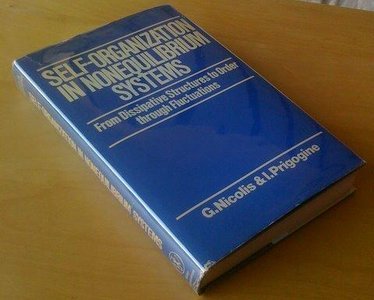
A second model for complexity at level 1 - chemical - has been developed by Ilya Prigogine on the thermodynamic of complex susystems far from equilibrium, particolarly on the so-called dissipative systems,  to be understood as an thermodynamical open system which works in a state far from thermodynamical equilibrium, exchanging energy, matter and/or entropy with the environment. Dissipative systems are characterized by spontaneous formation of  anisotropy, namely of complex and oredered patterns, sometimes chaotic. Sush sustems, when crossed by increasing flows of energy and matter, may also evolve, passing from instability phases and increasing the complexity of the structure (that is the order) and decreasing their entropy (negentropy).
The term dissipative system has been named by Prigogine at the end of the '60s, lwork for which he received the 1977 Nobel prize for chemistry. The contribution of Prigogine was that to bring attention toward the connection between order and energy dissipation, differently from the static and equilibrium situations generally studied until then, and contributing significantly to the birth of what today is called epistemology of complexity.
In recent years there has been developed a vocabulary of complexity with fterms like fluctuation, stability, phase transitions. All these terms refer to the problem of time, which was one of the problems studied since the beginning of Western civilization.
The existence of a physical time separated by a
philosophical time was a central issue for the concerns of many philosophers from Aristotle to Heidegger. The latter poses the question: what is time? He answered this question by saying that the time is difference, motion, it is a representation of the difference between what comes before and what comes after. This analysis was taken further by Heiddegger which defines a very strong difference between past and future. He emphasizes that it is not time as introduced by physicists to determine the difference. This explains the fact that science is not able to reach the essence in describing the universe.


Prigogine thinks that all the developments of science in the last decade have shown that time is an essential element of the physical universe. The fact that one is forced to speak of an evolving universe, because it is the only way to describe the events that are observed, is an evidence that the direction of time is not a creation of man but is inherent nature. That's why it is no longer possible to make a distinction between physical time and philosophical time.


According to Prigogine classical physics wanted to eliminate any reference to the history, the history was conceived as something that exists only because we do not understand the causes of a physical process. The universe, however, can not be attributed to independent events, it is not so simple. We also need stochastic events (probability, random, we need to reversibility. We need random events.
Prigogine claims a new scientific logic. On the basis of his view there is distrust on the classical idea that nature always follows the simplest way.
On the contrary, he argues that the operation of the machine-nature is due to the complexity of the irreversible processes. Prigogine comes to this idea analyzing the thermodynamical phenomenon known as entropy. In thermodynamics, entropy is a state function that is introduced with the second law of thermodynamics and which is interpreted as a measure of disorder of a physical system or the universe in general. According to this definition one can say, in a non-rigorous but explanatory form, that when a system moves from an ordered state to a disordered state its entropy increases.
In the historical evolution of the universe, there is indeed an exceptional event that denies the gradual transfer of energy from order to disorder (entropy. This event was the emergence of life on earth and the consequent existence of various forms of life characterized, like other irreversible processes, by self-organization. This latter is against the alleged balance of the natural order and thus against the anti-scientific idea of the simplicity of the phenomena, which should be contrasted with the complexity, that is necessarily the absence of energy balance (entropy) and physical disorder. It then develops the non-equilibrium physics with an underlying nonlinear dynamics. The most unexpected result of this is the awareness of the constructive role of non-equilibrium: far from equilibrium coherent states and complex structures are created that could not exist in a reversible world.
In this way, nature creates dissipative systems like living beings.

ILYA PRIGOGINE: THE EXPLORATION OF COMPLEXITY


“The fact that during growth living organisms actually show a decrease of entropy production during evolution up to the stationary state … also, the fact that their organization generally increases during this evolution [which] corresponds to the decrease of entropy as studied [leads one to puzzle as to why] the behavior of living organisms has always seemed so strange from the point of view of classical thermodynamics; that the applicability of thermodynamics to such systems has often been questioned. One may say that from the point of view of the thermodynamics of open and stationary systems [nonequilibrium thermodynamics] a much better understanding of their principal features is obtained.”
One of the biggest dissipative structures: the Great Red Spot on Jupiter su Giove taken by Voyager 1 in 1979

The coordinated movements of liquids and gases leading to patterns can also be observed in the laboratory This figure shows a hexagonal pattern of liquid helium in a vessel that is heated from below. This classical experiment was first done by Bénard (1900) with oil. In the middle of each cell, the liquid rises, cools down at the upper surface and then sinks down at its border
dissipative structure evolution in typhoon Matsa (2005)

Time, Structure, and Fluctuations
Ilya Prigogine
SCIENCE, VOL. 201, 1 SEPTEMBER 1978
Copyright 1978 by the Nobel Foundation.

The author is professor of physics and chemistry, Universite Libre de Bruxelles, Brussels, Belgium; director of the Instituts Internationaux de Physique et de Chimie (Solvay), Brussels; and professor of physics and chemical engineering and director of the Center for Statistical Mechanics and Thermodynamics, University of Texas, Austin 78712. This article is the lecture he delivered in Stockholm, Sweden, on 8 December 1977 when he received the Nobel Prize in Chemistry.

Summary
Fundamental conceptual problems that arise from the macroscopic and microscopic aspects of the second law of thermodynamics are considered. It is shown that nonequilibrium may become a source of order and that irreversible processes may lead to a new type of dynamic states of matter called "dissipative structures."
The thermodynamic theory of such structures is outlined. A microscopic definition of irreversible processes is given, and a transformation theory is developed that allows one to introduce nonunitary equations of motion that explicitly display irreversibility and approach to thermodynamic equilibrium. The work of the group at the University of Brussels in these fields is briefly reviewed. In this new development of theoretical chemistry and physics, it is likely that thermodynamic concepts will play an everincreasing role.


The Center for Complex Quantum Systems
Department of Physics | The University of Texas at Austin

Friday, February 25, 2011

planetary Tao mind


Below, the Ocean - the planet's only inhabitant, organic, sentient, unimaginably powerful, profoundly indifferent to humanity. Above, the space station set from Earth, pathetically hovering over Solaris in an attempt to fathom some of the oceans mysteries, to tap a little of its knowledge. Newest arrival at the station is Kelvin, psychologist, principal character of a science fiction novel which has all the makings of a classic. This station is all but deserted, its crew reduced to a couple of half-crazed, furtive creatures, who are men of high repute among their fellow scientists. Are there but the three of them on board? Kelvin soon finds out, or thinks he does, when he is visited in the middle of the night by a lady bearing an uncanny resemblance to his long dead wife.
This is a dense and profound book, a parable and a thriller written at several levels and yielding more at each examination, yet it remains extremely readable throughout.


logical causal Tao


LOGIC IS A POOR MODEL OF CAUSE AND EFFECT

We use the same words to talk about logical sequences and about sequences of cause and effect. We say "If Euclid's definitions and postulates are accepted, then two triangles having three sides of the one equal to thee sides of the other are equal each to each." And we say, "If the temperature falls below 0°C, then the water begins to become ice."
But the if…then of logic in the syllogism is very different from the if…then of cause and effect.
In a computer, which works by cause and effect, with one transistor, triggering another, the sequences of cause and effect are used to simulate logic. Thirty years ago, we sued to ask: Can a computer simulate all the processes of logic? The answer was yes, but the question was surely wrong. We should have asked: Can logic simulate all sequences of cause and effect? And the answer would have been no.
When the sequences of cause and effect become circular (or more complex than circular), then the description or mapping of those sequences onto timeless logic becomes self-contradictory. Paradoxes are generated that pure logic cannot tolerate. An ordinary buzzer circuit will serve as an example, a single instance of the apparent paradoxes generated in a million cases of homeostasis throughout biology. The buzzer circuit 


is so rigged that current will pass around the circuit when the armature makes contact with the electrode at A. But the passage of current activates the electromagnet that will draw the armature away, breaking the contact at A. The current will then cease to pass around the circuit, the electromagnet will become inactive, and the armature will return to make contact at A and so repeat the cycle.
If we spell out this cycle onto a causal sequence, we get the following:
If contact is made at A, then the magnet is activated.

If the magnet is activated, then contact at A is broken.
If contact at A is broken, then the magnet is inactivated.
If magnet is inactivated, than contact is made.
The sequence is perfectly satisfactory provided it is clearly understood that the if…then junctures are casual. But the bad pun that would move the ifs and thens over into the world of logic will create havoc:
If the contact is made, then the contact is broken.
If P, then not P.

The if…then of causality contains time, but the if…then of logic is timeless. It follows that logic is an incomplete model of causality.

Tuesday, February 22, 2011

Complex Tao level 0: Synergetic Tao

In searching new methodologies for complex systems which could overcome the difficulties of the classical ones, at physical level 0  Hermann Haken has developed the Synergetics method (from greek "working together"), created in the 70s-80s years in the field of quantum laser theory, specifically to explain the coherence of the emitted radiation, namely how photons into the laser cavity interact all together in a spatio-temporal way to form the high coherence  characteristic of the output laser radiation.
The laser radiation has two peculiar characteristics: the first is its monochromaticity, that is the light emission has a narrow wavelength (one-colored), the second is its coherence, as clear to anyone have seen a laser beam.


While the former is easily explained in terms of electron transitions between higher energy levels to lower, producing a photon energy very definite, the second can not be explained by the characteristics of the emission of photons in the laser cavity, which should emit independently of each other, and then incoherently.
This application example clarifies some key concepts used in Synergetics in a qualitative way. In the gas lasers the emitting atoms are locked in a tube with the ends of the semi-reflective mirrors that act as resonator for the emitted light. The mirrors are designed in order to reflect light in the axial direction often enough so that the corresponding wave remains for a long time within the device and can interact strongly with the atoms through the phenomenon of stimulated emission.
The atoms are excited from the outside, eg by a light pump source. After being excited, each atom can spontaneously emit a trace of light. In the usual case of a lamp, these tracks of light are emitted independently of each other incoherently, and the amplitudes are distributed as a Gaussian. When the pump intensity is increased beyond a critical value, called laser threshold, where it starts the population inversion - or when there are more electrons in higher energy levels than on the fundamental - the current state gives way to a single wave with amplitude stability on which the fluctuations of small amplitude and phase overlap. The pump intensity acts as control parameter. At its critical value, the old state becomes unstable. The emerging coherent wave acts as a order parameter that through stimulated emission forces the electrons of the gas molecules to emit light in a coherent way. This action by the order parameter over single parts of the system has been called by Haken enslavement principle. In this case it can be seen that from 1018 degrees of freedom, in which any of the 1018 atoms in the cavity emit independently of each other, and therefore the total sum is incoherent, one switch to a single degree of freedom, the coherent laser mode over thresholdl. If the pump power is still increased may appear further instabilities and a variety of temporal patterns, but even spatio-temporal, such chaotic laser light or very short laser pulses. The laser threshold, where stimulated emission occurs, show typical characteristics of a phase transition of a system  out of thermal equilibrium, such critical damping, critical fluctuations and simmetry breaking.
The high laser coherence is therefore a cooperative effect of self-organization, and the synergetic method of the enslavement principle between order parameters and the  slaved subsystems gives the relationship between macroscopic and microscopic parameters of the complex system.


Haken has expanded in subsequent years the calculation model for synergetic to a range of disciplines from chemistry to biology to economics to the study of brain and cognitive sciences and, more generally, to any form of self-organization in complex systems that exhibit an emergent behavior. Synergetics therefore stands as a new authentic methodology to address Complexity.

 In the Haken words:
"The systems under experimental or theoretical consideration I sistemi in esame sperimentale o teorico are subject to control parameters which can be fixed from the external or generated in part from the system itself. An example for an external control parameter is the absorbed power in a gas laser by the injected electrical current. An example for a internal generated control parameter are the hormones in the human body or the neurotransmitters in the brain. When the control parameters reach some specific critical values the system may become instable and to adopt a new macroscopic state. Close to these instability points, a new set of collective variables may be identified: the order parameters. They have, at least generally, a low dimensional dynamic and characterized the macroscopic system. Since the cooperation of the single parts allows the existence of order parameters which in turn determine the bahavior of the individual partsi, we speak of circular causality. According to the enslavement principle, the order parameters determine the bahavior of the individual parts, the enslaved subsystems, which can be still subjected to fluctuations. At a critical point, a single order parameter may be subjected to a non-equilibrium transition phase (bifurcation), with simmetry breaking,  with a  slowing down of critical fluctuations. 
Synergetic ha several links to other disciplines, such complexity theory"

In general, the abused term synergy may indicate a cooperative effect of reinforcement/stabilization among different internal processes of the system, or among certain internal and other external to the system.

In the  figure, for example, the two recursive closed processe red e blue are coupled by a third process which may habe synergetic effects, making a new three processes set which may have different qualities from those of the individual processes.


Wednesday, February 16, 2011